
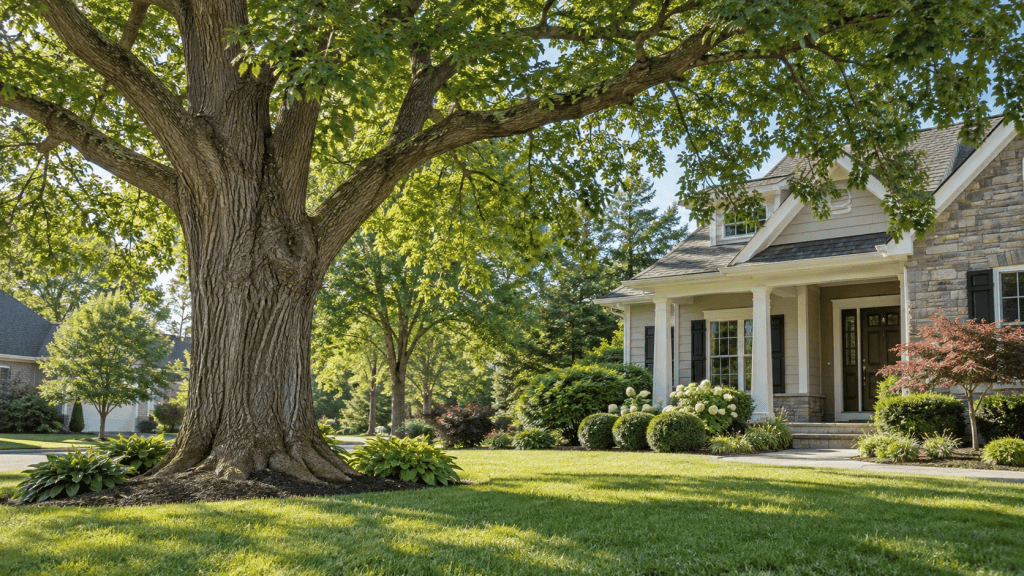
If you’re looking at a questionable tree in your yard and wondering, “Does this tree really need to be removed?” you’re asking the right question.
Tree removal shouldn’t automatically be the first solution.
A mature tree can take decades to replace, and many tree problems can be addressed with proper pruning, removal of damaged limbs, ongoing monitoring, or other professional tree care. But there are also times when a tree has become too damaged, unstable, or unhealthy to safely remain where it is.
The challenge for homeowners is knowing the difference.
Some warning signs are obvious. Others aren’t. And because every tree is different, spotting one of the signs below doesn’t necessarily mean the tree has to come down…it means it’s time to have someone qualified take a closer look.
Here are seven signs St. Louis homeowners shouldn’t ignore.
1. The Tree Has Large Dead or Dying Branches
A few small dead twigs aren’t necessarily cause for alarm. Large dead limbs are another story.
Dead branches become weaker over time and are more likely to break away from the tree, particularly during the strong winds, thunderstorms, ice, and other severe weather we experience in the St. Louis area.
During the growing season, look for large sections of the canopy that:
- Have no leaves while surrounding branches do
- Have brittle or peeling bark
- Appear gray or noticeably different from healthy branches
- Contain broken limbs caught overhead
- Have experienced repeated branch failure
Where those branches are located matters, too.
A dead limb hanging over an unused section of the yard presents a very different level of risk than one hanging over your roof, driveway, sidewalk, patio, or children’s play area.
Does that mean the whole tree needs to be removed?
Not necessarily.
If the rest of the tree is healthy and structurally sound, professional tree trimming may be all that’s needed. But widespread dieback throughout the canopy can indicate a larger problem that deserves evaluation.
2. The Trunk Has a Significant Crack or Split
Tree trunks and large limbs support an enormous amount of weight.
A significant crack…especially one that is getting larger…can indicate that part of the tree is beginning to separate or that there is a structural weakness developing inside the trunk.
Pay particular attention to:
- Long vertical cracks in the trunk
- Splitting where two large trunks meet
- Cracks at the base of a major limb
- Newly opened cracks following a storm
- Sections of the trunk that appear to be pulling apart
Not every crack means imminent failure, and it can be difficult to determine the severity of a crack just by looking at it from the ground.
That’s where a professional evaluation becomes important.
The real question isn’t simply “Is there a crack?” It’s whether the crack is affecting the structural integrity of the tree.
3. The Tree Has Started Leaning
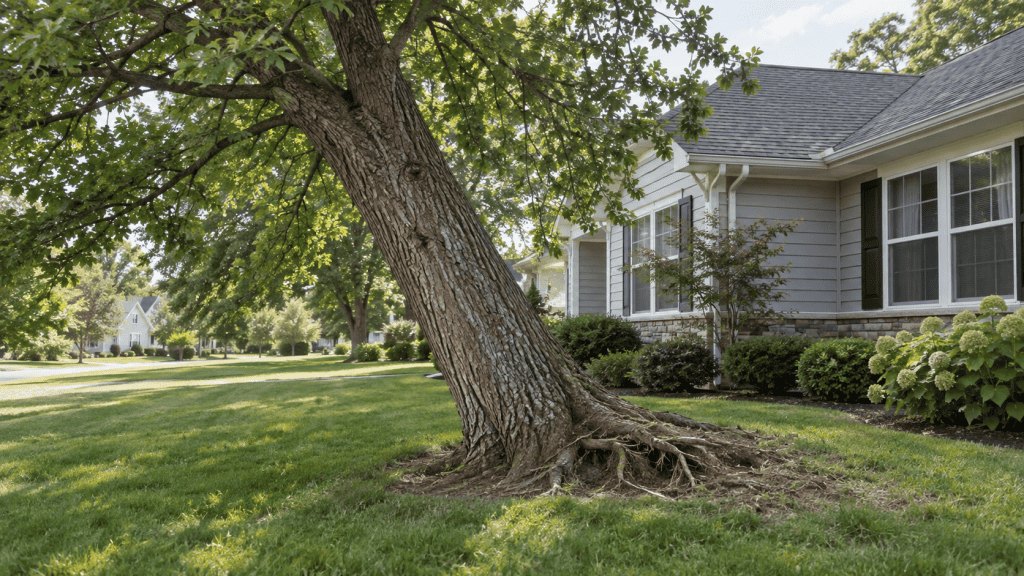
Here’s an important distinction: a tree that has always leaned is not the same thing as a tree that has recently started leaning.
Many perfectly healthy trees grow at an angle because of sunlight, competition from nearby trees, terrain, or the way they developed when they were young.
A new lean deserves more attention.
Look around the base of the tree for changes such as:
- Soil lifting on one side
- Newly exposed roots
- Cracking in the soil around the trunk
- A visible gap between the trunk and surrounding soil
- Roots appearing to pull from the ground
A noticeable change following strong winds, saturated soil, or a major storm can be particularly concerning.
If a large tree suddenly appears to be leaning toward your home or another occupied area, don’t try to straighten it or investigate unstable roots yourself. Have it professionally evaluated.
4. You See Decay, Cavities, or Fungal Growth
Trees are remarkably resilient.
A tree can sometimes continue producing leaves even when decay is developing elsewhere in its structure. That’s why a green canopy by itself doesn’t always tell the whole story.
Potential warning signs include:
- Large cavities in the trunk
- Hollow areas
- Soft or crumbling wood
- Significant sections of missing bark
- Decay around old wounds
- Mushrooms or fungal growth on the trunk or near the base
- Areas of the trunk that appear unusually damaged or deteriorated
Seeing a mushroom near a tree does not automatically mean the tree is dying.
But certain types of fungal growth on the trunk, root flare, or major roots can be associated with decaying wood.
What matters is the location and extent of the decay—and whether enough strong, healthy wood remains to support the tree.
That’s difficult to determine without experience.
5. The Roots Have Been Damaged
When homeowners think about tree health, they usually look up. Sometimes the bigger issue is underground.
A tree’s roots provide water and nutrients, but they also help anchor an enormous structure into the ground. Significant root damage can affect stability even when the canopy still looks relatively healthy.
Root damage can happen during:
- Driveway replacement
- Sidewalk installation
- Construction
- Trenching
- Utility work
- Excavation
- Major landscaping projects
- Changes in soil grade
- Heavy equipment use around the tree
If large roots were recently cut near the trunk of a mature tree, don’t assume everything is fine simply because the tree still has leaves.
Root-related decline can take time to become visible above ground.
If you’re concerned about a mature tree following construction or excavation around its root system, that’s a good reason to have it evaluated.
6. Major Trunks or Branches Have Weak Connections
Have you ever seen a tree that looks almost like two trees growing out of one trunk?
Multiple trunks aren’t automatically a problem, but some connections are stronger than others.
A tight V-shaped connection between two large stems can sometimes develop differently from a wider, stronger attachment. As those trunks grow taller, wider, and heavier, the connection between them has to support an increasing amount of weight.
Watch for:
- Cracking where large trunks meet
- A seam that appears to be opening
- Bark compressed between two large stems
- One trunk beginning to pull away from another
- Previous failures in the same area
Again, this doesn’t mean every tree with two trunks needs to come down.
It means the structure is worth evaluating—particularly if the tree is large or located close to your home.
7. The Tree Has Recently Been Damaged by a Storm
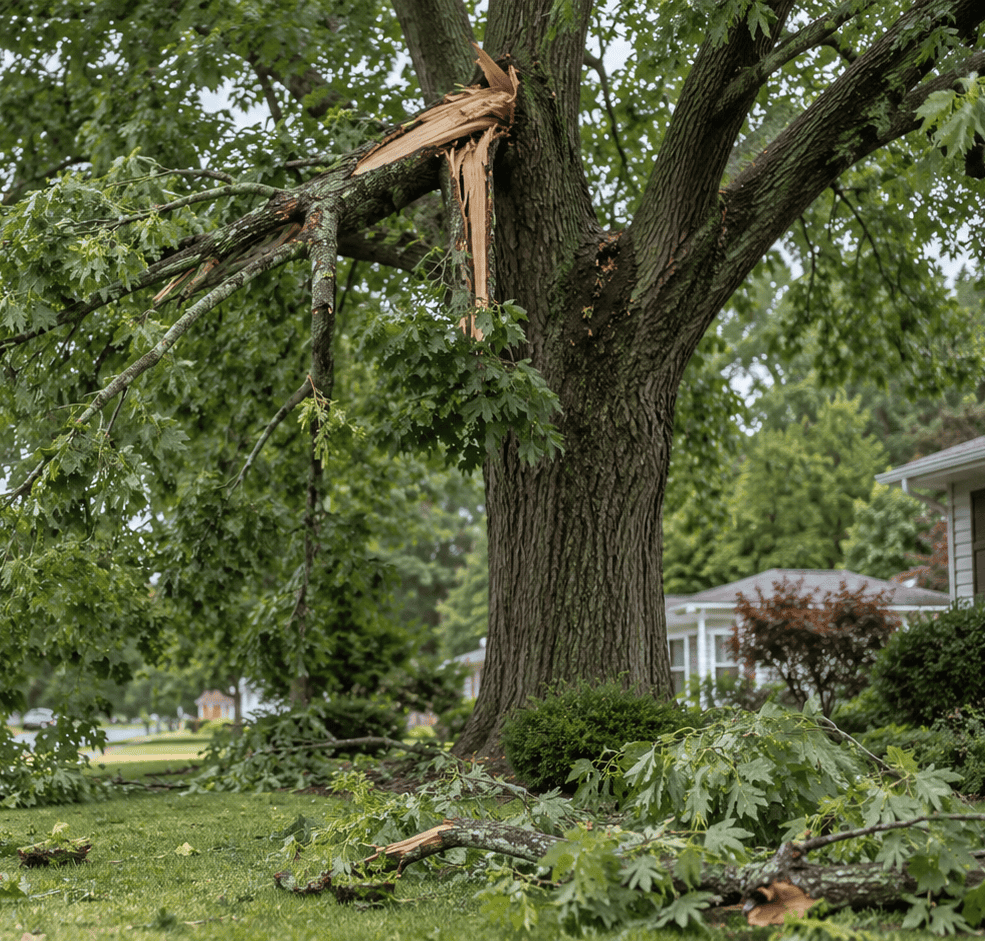
After severe weather, it’s tempting to look outside, see that the tree is still standing, and assume everything is okay.
Take another look.
Storm damage can leave behind:
- Broken limbs
- Hanging branches
- Torn bark
- New cracks
- Split trunks
- A changed lean
- Damaged roots
- Partially uprooted trees
- Large sections missing from the canopy
Storm damage does not automatically mean a tree needs to be removed.
A tree with limited damage and a healthy remaining structure may be able to recover.
Storm-damaged limbs can also be twisted, bent, or under significant tension, making cleanup dangerous for an inexperienced homeowner. Before assuming the tree is a total loss…or climbing a ladder with a chainsaw…have the damage properly assessed.
So, How Do I Know If My Tree Actually Needs to Come Down?
There isn’t one single sign that answers that question for every tree.
Instead, an arborist looks at the bigger picture:
- How healthy is the tree?
- How structurally sound is it?
- Is the problem isolated or widespread?
- Can pruning or another tree-care solution reasonably correct it?
- What would the tree hit if it failed?
- Is the risk likely to increase as the tree continues growing?
A tree standing in the middle of an open field and the same tree standing six feet from a bedroom window may warrant different levels of concern.
That’s why professional tree care isn’t simply about deciding whether a tree is “good” or “bad.” It’s about evaluating the tree and its surroundings.
Can a Dangerous Tree Be Saved?
Sometimes, yes.
Depending on the problem, recommendations might include:
- Removing dead or damaged limbs
- Corrective pruning
- Reducing excess weight in a specific area
- Monitoring the tree over time
- Addressing tree-health concerns
- Removing only the hazardous portion of the tree
In other situations, damage or decay may be too extensive for the tree to remain safely in place.
If removal is ultimately recommended, you should understand why.
A reputable tree professional should be able to explain what they’re seeing, what concerns them, and why trimming, monitoring, or another alternative is or isn’t appropriate.
Don’t Wait Until the Tree Is on the Ground to Ask the Question
Many tree emergencies don’t begin the day a tree falls.
There may have been a declining limb, worsening crack, damaged root system, or other warning sign developing beforehand.
You don’t need to panic every time you notice something unusual on a tree. But you also don’t need to guess.
If something has changed, looks concerning, or simply doesn’t seem right, having it evaluated now can help you understand your options before the next major storm makes the decision for you.
Worried About a Tree on Your St. Louis Property?
Complete Tree Service of St. Louis has been caring for trees throughout the St. Louis area since 1991. Complete Trees is fully insured, has certified arborist expertise, and provides professional tree removal, tree trimming and pruning, storm cleanup, stump grinding, and crane and bucket truck services.
If something about a tree on your property doesn’t look right, you don’t have to figure it out on your own. Our team can evaluate the tree, explain what we’re seeing, and help you understand whether trimming, monitoring, or removal is the best next step.
Request a free estimate today and let Complete Trees help you make an informed decision about your property.