
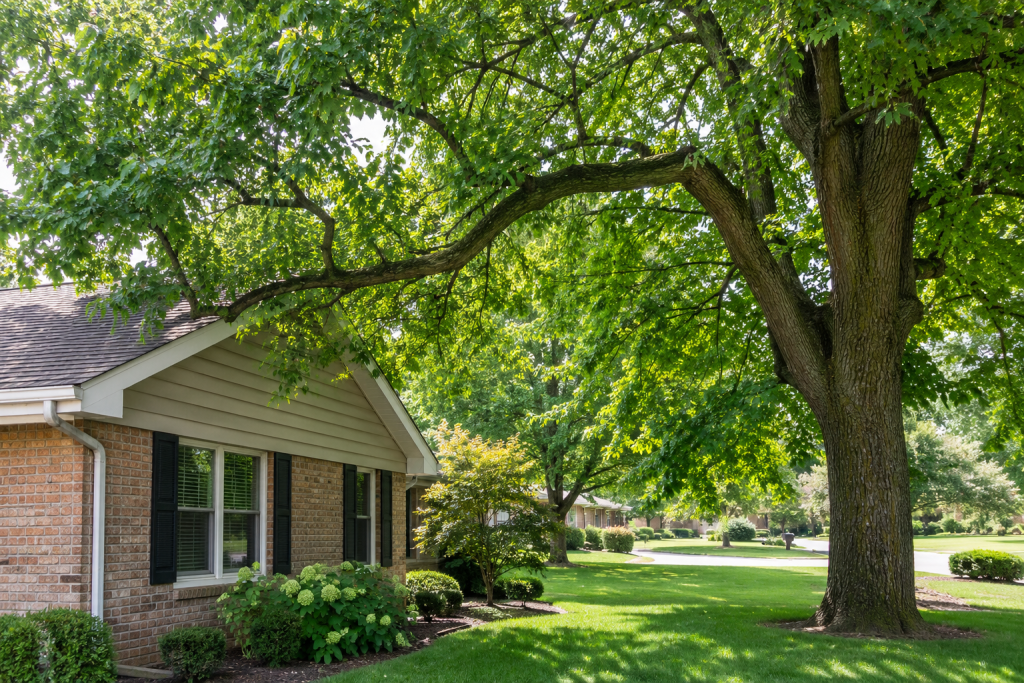
You know something needs to be done with the tree.
Maybe branches are hanging over the roof.
Maybe part of the canopy looks dead.
Maybe the tree has gotten too close to the house, or you have started noticing cracks, broken limbs, or other changes that make you uncomfortable.
But does the whole tree really need to come down?
Or would trimming solve the problem?
That is one of the most common questions homeowners have, and the answer depends on much more than the size of the tree.
Sometimes professional pruning can correct the issue while allowing a healthy tree to remain for years.
Other times, trimming would only postpone a larger problem.
Here are some of the biggest things to consider when deciding whether a tree needs to be trimmed or removed.
When Tree Trimming May Be Enough
Professional trimming is often the better option when the tree itself is healthy and the concern is limited to particular branches or portions of the canopy.
Pruning can be used to remove dead, damaged, or poorly positioned branches and reduce certain hazards while preserving the rest of the tree. Missouri Extension specifically notes that pruning can help remove dying or broken branches that create hazards and improve tree structure when done correctly.
Here are a few situations where trimming may make sense.
A Few Branches Are Dead or Damaged
One dead branch does not necessarily mean the entire tree is dying.
If most of the canopy is healthy and the problem is isolated, removing the affected branch may be all that is needed.
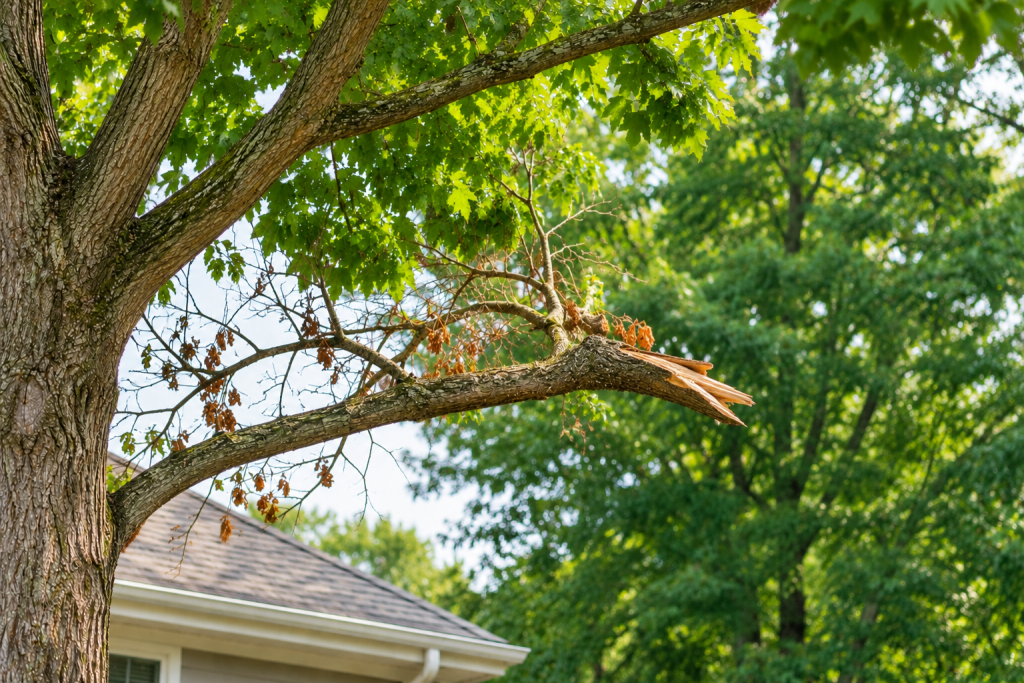
This is especially common after storms, when one portion of a tree may be damaged while the rest remains structurally sound.
Branches Are Growing Too Close to the House
A healthy tree can still create problems when branches begin touching the roof, gutters, siding, or nearby structures.
Selective trimming may provide needed clearance without sacrificing the whole tree.
The goal should be to remove what is necessary while maintaining the natural structure and balance of the tree.
Branches Are Hanging Over a Driveway, Sidewalk, or Play Area
Sometimes the concern is not the overall health of the tree but where particular branches are located.
Removing dead, damaged, or poorly positioned limbs over high-use areas can reduce risk while allowing the tree to remain.
The Tree Has Become Too Dense or Unbalanced
Proper pruning can improve structure and remove problematic branches.
That does not mean aggressively cutting back the entire canopy.
In fact, excessive pruning or topping can create additional problems and weaken a tree rather than improve it.
When Tree Removal May Be the Better Option
There are situations where pruning simply cannot correct the underlying problem.
That does not mean one warning sign automatically requires removal.
It means the condition of the whole tree needs to be considered.
Missouri Extension recommends consulting a professional arborist when a large tree is hollow, has a cracked trunk, or shows extensive branch dieback to determine whether it represents a hazard and should be removed.
The Tree Is Dead or Mostly Dead
A completely dead tree cannot recover.
As dead wood continues to deteriorate, branches and sections of the tree can become increasingly unpredictable.
If a substantial portion of the canopy has died or the entire tree is no longer alive, removal may be the safest long-term option.
There Is Significant Trunk Decay
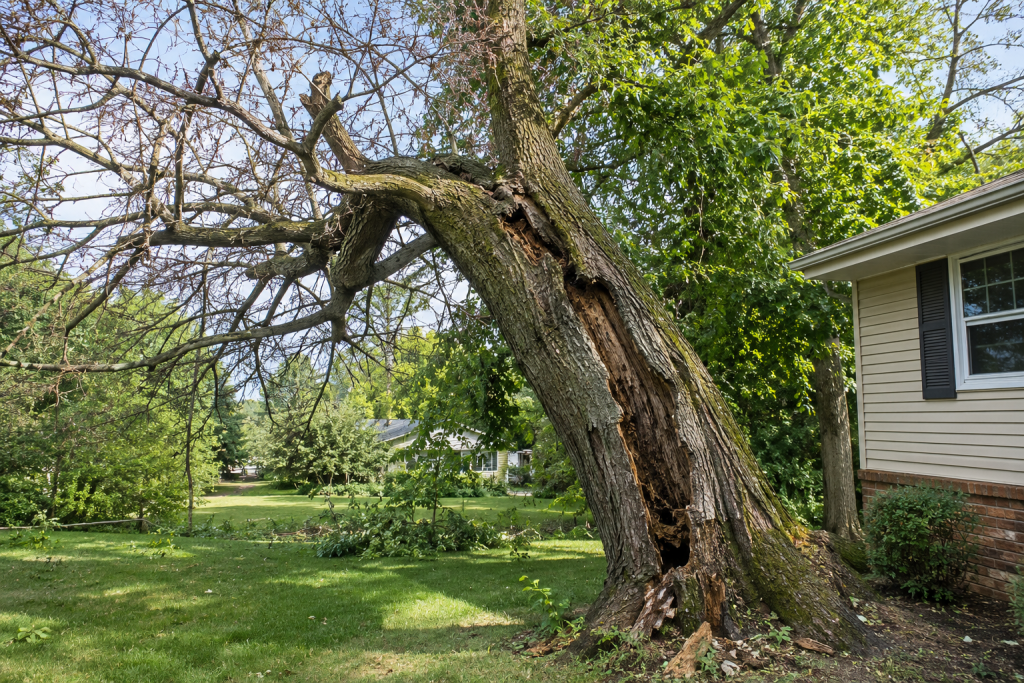
A tree may still have leaves even when serious decay is developing inside the trunk.
Large cavities, extensive rot, fungal growth associated with decaying wood, or hollow sections can affect the structural strength of the tree.
The key question is not simply whether decay is present.
It is whether enough healthy, sound wood remains to support the tree safely.
The Trunk Has a Major Crack or Split
Minor bark damage and a significant structural crack are very different problems.
A deep crack through the trunk or a major split where large stems meet may affect the tree’s ability to support its own weight.
Pruning a few branches may not solve a structural problem occurring in the main trunk.
The Root System Is Severely Damaged
Roots are what anchor the tree.
Major root damage from construction, excavation, trenching, soil changes, or storms can compromise stability even when the canopy still looks healthy.
If enough structural roots have been damaged, pruning may not be able to correct the underlying risk.
The Tree Has Begun to Lean Suddenly
Some trees naturally grow at an angle and remain stable for decades.
A tree that has recently changed position is different.
A new lean accompanied by lifted soil, exposed roots, or movement around the base can indicate that the root system has shifted.
That situation deserves professional evaluation.
Not sure whether the warning signs you’re seeing are serious? Read our guide to 7 signs your tree may need to be removed.
What If Only Part of the Tree Looks Bad?
This is where the decision becomes less obvious.
A tree may have one large dead limb, storm damage on one side, or a portion of the canopy that is declining while the rest looks healthy.
In some cases, professional pruning can remove the damaged portion and preserve the tree.
In others, the damaged section may represent such a large percentage of the tree…or create such a significant structural imbalance—that removal becomes the better option.
There is no reliable percentage or rule that works for every tree.
The species, age, location, structure, extent of damage, and what surrounds the tree all matter.
Does the Location of the Tree Change the Decision?
Absolutely.
The same defect can create very different levels of concern depending on where the tree is standing.
Imagine two trees with the same questionable branch.
One is growing in the middle of an open field.
The other is six feet from a house with the branch hanging directly over a bedroom.
The condition of the branch may be the same.
The potential consequence if it fails is not.
The International Society of Arboriculture recommends considering both tree defects and the possible “targets” around the tree, such as homes, vehicles, power lines, and landscape features. In some situations, risk can be reduced through pruning or other management rather than removing the entire tree.
That is why tree-care decisions should consider both the tree and what is underneath it.
Can You Trim a Tree to Keep It From Getting Too Big?
Sometimes pruning can help manage clearance or structure, but trying to permanently keep a naturally large tree small through aggressive cutting usually creates more problems than it solves.
This is where tree topping often enters the conversation.
Topping removes large portions of the upper canopy or cuts major branches back indiscriminately.
It may make the tree look smaller temporarily, but it can leave large wounds and encourage weak new growth.
Missouri Extension specifically advises against tree topping except in very limited circumstances.
If a tree has simply outgrown the space where it was planted, repeatedly cutting it back may not be a good long-term solution.
If you’re wondering when pruning should actually be done, see our guide on the best time to trim trees in St. Louis.
Does a Tree Near My House Automatically Need to Be Removed?
No.
Many large, mature trees grow near homes for decades without causing problems.
Proximity alone is not a reason to remove a healthy tree.
What matters is the tree’s condition, structure, root system, branch placement, and the amount of clearance around the home.
Sometimes selective pruning provides exactly what is needed.
Sometimes the tree has become too large, damaged, or structurally compromised for the location.
That is why an evaluation is more useful than making the decision based only on distance from the house.
Can Storm-Damaged Trees Be Saved?
Sometimes.
A broken branch after a storm does not automatically mean the entire tree has to come down.
If the trunk and major structure remain sound, removing damaged limbs may allow the tree to recover.
But storm-damaged trees can also contain hanging branches, split wood, and sections under significant tension.
That type of work can be unpredictable and dangerous.
If there are large broken limbs, significant splitting, or damage high in the canopy, it is better to have the tree evaluated before attempting cleanup yourself.
How Do You Decide Between Trimming and Removal?
A professional evaluation looks at the entire situation.
Questions may include:
- Is the tree alive and generally healthy?
- Is the problem limited to one branch or widespread?
- Is there significant trunk or root damage?
- Has the tree changed position?
- Can the problem be corrected through pruning?
- Would removing branches create an unstable or badly unbalanced tree?
- What is underneath or around the tree?
- Is the tree likely to continue causing the same problem?
- Is there enough healthy structure left to justify preserving it?
The goal should not be:
“Can we remove this tree?”
It should be:
“What does this tree actually need?”
When Should You Call a Professional?
You do not have to know the answer before you call.
That is the point of having the tree evaluated.
If you are noticing dead limbs, cracks, decay, root damage, a new lean, storm damage, or branches creating problems around your home, an experienced tree professional can help determine whether trimming is enough or removal is the better long-term solution.
Large-tree pruning and removal can also be dangerous work. Missouri Extension recommends hiring a competent, insured arborist when mature trees require professional pruning, particularly when the work is high off the ground or involves large branches.
Not Sure Whether to Trim It or Remove It?
Complete Tree Service of St. Louis has been caring for trees throughout the St. Louis area since 1991.
Our team provides professional tree trimming and pruning, tree removal, storm cleanup, stump grinding, crane and bucket truck services, and forestry mulching for residential and commercial properties.
If something about a tree on your property has you wondering what to do next, you do not have to make that decision on your own.
Request a free estimate today. We’ll take a look at the tree, explain what we’re seeing, and help you determine whether trimming, removal, or another approach makes the most sense.